Tansy and I have taken the challenge to read every book written by Agatha Christie, in order of publication and we’re blogging as we go along. We’re calling it the Agathon! . As a warning, there may be spoilers, though they will be signposted. Tansy's post is here: http://tansyrr.com/tansywp/agathon-3-murder-on-the-links-1923/
3 - The Murder on the Links (1923)
Featuring: Hercule Poirot and Arthur Hastings
KATHRYN SAYS: Well I’m happy to report that in ‘The Murder on the Links’, Poirot is not longer housesharing in the countryside with seven other Belgians, but is instead flatsharing in London with Hastings! We find him at breakfast, bemoaning the lack of interesting cases for him to solve - rather he is receiving requests to speak to the local Scout group. But, of course, an interesting letter then turns up almost immediately, urging Poirot to travel to France to aid a millionaire apparently in fear of his life.
Murder on the LinksBut I’m getting ahead of myself. The book actually open with Hastings meeting a mysterious and somewhat irreverent young lady on a train, AND HE FALLS IN LOVE. Perhaps not right there on the train, but during the course of the book, Hastings finds his Cinderella. And we’re not just talking about the normal misguided Hastings-love, but a full-blown, sacrifice-his-friendship-with-Poirot-if-he-must type of love. Indeed having read this book before, the thing I remembered most from my first reading was Hastings defiant actions to save his beau (Small spoiler: she didn’t do it, phew.). What’s more, Hastings’ Cinderella appears to be delightful. She is impertinent, devious, acrobatic, and not afraid to call him prehistoric when he expects her to be more horrified about a murder than she is.
Barring the fact that I have read this book before, ‘The Murder on the Links’ does make me question what I consider the ‘typical’ Poirot mystery. Rather than occurring in one location, there’s a lot of travelling in this book and scenes change quire rapidly. Furthermore, after wondering in my review of ‘The Mysterious Affair at Styles’ whether there would ever be a Poirot book without the traditional Poirot-gathers-everyone-in-a-room-and-tells-em-who-dunnit scene, here we are in only his second book and THERE ISN’T ONE! Instead the murderer is revealed after Poirot sets a trap to catch them in the act.
As noted in previous reviews by Tansy, Christie still seems to be making a commentary on murder mysteries in her text, with the appearance of a rival Detective to solve the mystery - Monsieur Giraud. He is the polar opposite of Poirot and from Christie’s description we know we should not like him from the start. Poirot’s commentary on Giraud’s detective style is entertaining and I particularly liked his commentary on the ‘romantic’ idea that all important clues must be infinitesimal. As Poirot says, ‘A clue of two feet long is every bit as valuable as one measuring two millimetres!”
Finally, as a postscript, ‘The Murder on the Links’ was available from my library as a graphic novel, so I got that out too. Alas, I didn’t think much of the translation. I found a lot of characterisation and plot details missing, while the smooth rendering of Poirot’s figure seemed to border on parody. It simply didn’t have the emotion or drama of the original novel.
TANSY SAYS: Yep, we’re back in meta commentary territory again - or in fact, this being only Christie’s third novel, we’ve never left it. The story opens with reference to a compelling opening to a story (“Hell!” said the Duchess) and then goes on to rework it for Hastings’ own purposes. I also felt that the whole plot (which is utterly preposterous, relying on several coincidences colliding at once) hinged largely on a couple of people designing an imperfect murder mystery scenario based on the conventions of the genre. Christie’s universe is one in which her characters are immersed in the appropriate (for the story they’re in) body of pop culture, which goes to show that all those film & TV makers in the 90’s weren’t as smart as they thought they were!
I love Cinderella - though I’m not sure she’s ever as awesome as she is in that opening scene, bowling Hastings over with her unladylike declarations and wicked sense of humour. I haven’t yet decided if she’s played by Katherine Hepburn or Lauren Bacall, but she’s just that type, and I can’t for the life of me see what she sees in him!
Poirot is intriguing me as a character, probably because I was so uninterested in him in my younger days (I preferred Miss Marple) and because I never read these early books. He’s so enabling of Hastings’ bad behaviour, and a complete matchmaker, though he also delights in being several steps ahead of everyone. If he reminded me of Sherlock Holmes in his first book, his twinkly eyes in this one are making me think more of the Doctor. He seems to live on a different plane of reality to everyone else!
I think the solution is over-complicated for a Christie, as I said before. Such a mish mash of events colliding on the one night! I also think it’s odd that no one ever suggested that the young pair at the centre of the story might actually be brother and sister, which seemed to me to be a definite possibility considering the timing of the whole thing. On the whole, the pleasure of this one is from the interactions between Hastings, Poirot and Cinderella rather than the story itself, though I did appreciate that Hastings did so much working-out-of-stuff in his own brain, even if he was often wrong. And I liked the little detail with the daggers, and how the ‘one of a kind’ murder weapon was actually not, which can be seen as symbolic considering the storyline of the sisters, Bella and Dulcie.
As a side note, did you notice that the sisters in this story are called Bella and Dulcie? Their parents weren’t giving them a lot to live up to at ALL!
Can’t help thinking Poirot is so keen to marry Hastings off so he can be rid of him! Though I see there’s at least one more book coming which features the duo, so look forward to seeing how things turn out with the romance. Will we be seeing Mrs Cinderella Hastings? I loved the bit where her acrobatic skills and sturdy wrists came in super handy, and can totally see Poirot thinking she might actually make a better partner in crime.
COMING SOON
4. The Man in the Brown Suit (1924)
Anne Beddingfeld, Colonel Race
Poirot Investigates (1924)
Short Stories.
5. The Secret of Chimneys (1925)
Anthony Cade, Superintendent Battle
Showing posts with label reviewing. Show all posts
Showing posts with label reviewing. Show all posts
Saturday, 11 June 2011


Wednesday, 13 April 2011
Agathon #2: The Secret Adversary (1922)
Tansy and I have taken the challenge to read every book written by Agatha Christie, in order of publication and we’re blogging as we go along. We’re calling it the Agathon! . As a warning, there may be spoilers, though they will be signposted. Tansy's post is here: http://tansyrr.com/tansywp/agathon-2-the-secret-adversary-1922/
2 - The Secret Adversary (1922)
Featuring: Tommy and Tuppence, Inspector Japp (mentioned)
KATHRYN SAYS: I think it’s fascinating that Agatha Christie is now best known as a writer of Miss Marple and Hercule Poirot murder mysteries, and here we are at book two at the Agathon and it’s a spy novel!
‘The Secret Adversary’ opens with childhood chums Tommy Beresford and Tuppence (Prudence) Cowell running into each other in London. World War I is over and there is a dearth of jobs for both ex-VAD women, like Tuppence, and ex-Army men like Tommy. They decide to form a joint venture the "The Young Adventurers, Ltd.", and hijnks ensue, as they are become embroiled in finding a missing American girl and tracking down a spy ring that is threatening to bring down the British Government. Even though I had already read it before, I found it quite exciting.
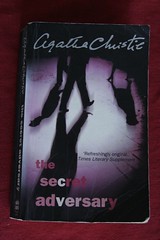 Is it a good spy novel? Well, given what I’ve read of John le Carre and Frederick Forsythe (who to be fair did write about the Cold War, whereas this is between WWI and WWII), I’m not sure it’s a particularly accurate one. Other than Mr Brown, the villians are cardboard cutouts -there’s a Russian and a German and a man from The Union (gasp!), and an Irishman from Sinn Fein. I have no idea how it actually relates to the politics of the time, but it comes over as a bit simplified. However, the level of detail in the political, erm, plot, contrasts signficantly against those parts of the novel that are rendered in lovely detail, such as the very detailed and specific description of how Tuppence went about posing as a maid for Rita Vandermeyer (and her qualifications for doing so). And, at the heart of this very jolly spy book, there is a murder and a mystery and Christie weaves these both into the story very well (though perhaps with a few less red-herring-y clues as in a Poirot novel). I also have to note that I *love* that this is a spy book where eating is important! Tommy and Tuppence are continually sitting down to buns or a good lunch of sole (particularly once they are ensconced at the Ritz).
After Tansy noted Hasting’s propensity for ill-advised love in her review of ‘The Mysterious Affair of Styles’, it dawned on me that Agatha Christie books actually have a fairly high romance quotient. Two books in and we are two for two on ill-advised marriage proposals, for example. I’ll be keeping an eye out for more romance in books to come. I don’t want to include spoilers for ‘ The Secret Adversary’, but I will note that Christie writes the sort of Repressed English Love that made me so fond of Mr Darcy and Elizabeth Bennett, and this certainly something interesting to realise about both myself and Agatha.
So. In summary I love Tommy and Tuppence - or perhaps more accurately I am fond of Tommy and I love Tuppence (I have failed to wax lyrical about Tuppence’s independence and initiative, but yea she is awesome). Christie only wrote 5 Tommy and Tuppence books (4 novels and 1 short story collection) over 50 years, approximately one every decade and one of the things I’ve been looking forward to particularly in the Agathon is reading them in order, and watching how the characters grow and age with each book. I would love to know what prompted her to write about Tommy and Tuppence in her second book, after having made what appears to have been a promisinig start with Poirot in ‘Styles’ (if anyone can point me towards a good biography of Christie that tells me this, please leave comment!)
TANSY SAYS: Hijinks ensue indeed. This novel is utterly bonkers! It feels more like a screwball comedy than a mystery or spy novel, and I find it fascinating that once again we are getting meta-commentary about genre conventions from Christie in the mouths of her characters - in this case I was particularly charmed by Tommy’s ruminations on how hard it was to follow a person in a cab in real life, as opposed to the cinema!
The first quarter of the plot is so entirely dependent on crazy coincidence that I got the feeling that Tommy and Tuppence were both completely aware that they were in a novel, and determined to make the most of it. Halfway through the story, though, the banter and the jolly japes become rather grim in a scene which makes it clear (or did at least to me) that one of two people our rapscallion heroes have in their confidence is actually a bad un - and very cleverly, the novel twists back and forth on the question of which right to the end.
I’m glad we had this interesting point, because otherwise the disastrously long separation between Tommy and Tuppence threatened to bore me - Tuppence remains interesting when her partner in (solving) crime is absent, but Tommy rather less so, except when he is talking about Tuppence.
But oh - I wouldn’t have cared if the plot was ten times duller than it is, not when these two are around with their suppers at the Ritz and their pound notes, and simmering affections below banter and bluff. I’m rather sad to know that I won’t get to see *this* Tommy and Tuppence, the careless twenty-somethings on the verge of real life, in future books, but I am terribly interested to see how they grow up.
As a side note, I love the fact that this novel is so deeply rooted in its time - from the Lusitania to the war history of our heroes (Tuppences wartime career is hilarious in the detail she recounts) and all manner of other social detail. I always find it fascinating to read novels that feel like historical novels - that is, are aware of things which people would later find of historical interest, if that makes sense.
Also, I’m pretty sure that significant chunks of this novel were pinched for a Trixie Belden plot. Just saying.
COMING UP SOON:
3. The Murder on the Links (1923)
Hercule Poirot, Arthur Hastings
4. The Man in the Brown Suit (1924)
Anne Beddingfeld, Colonel Race
5. Poirot Investigates (1924)
A short story collection! (presumably involving Poirot :-)
2 - The Secret Adversary (1922)
Featuring: Tommy and Tuppence, Inspector Japp (mentioned)
KATHRYN SAYS: I think it’s fascinating that Agatha Christie is now best known as a writer of Miss Marple and Hercule Poirot murder mysteries, and here we are at book two at the Agathon and it’s a spy novel!
‘The Secret Adversary’ opens with childhood chums Tommy Beresford and Tuppence (Prudence) Cowell running into each other in London. World War I is over and there is a dearth of jobs for both ex-VAD women, like Tuppence, and ex-Army men like Tommy. They decide to form a joint venture the "The Young Adventurers, Ltd.", and hijnks ensue, as they are become embroiled in finding a missing American girl and tracking down a spy ring that is threatening to bring down the British Government. Even though I had already read it before, I found it quite exciting.
Is it a good spy novel? Well, given what I’ve read of John le Carre and Frederick Forsythe (who to be fair did write about the Cold War, whereas this is between WWI and WWII), I’m not sure it’s a particularly accurate one. Other than Mr Brown, the villians are cardboard cutouts -there’s a Russian and a German and a man from The Union (gasp!), and an Irishman from Sinn Fein. I have no idea how it actually relates to the politics of the time, but it comes over as a bit simplified. However, the level of detail in the political, erm, plot, contrasts signficantly against those parts of the novel that are rendered in lovely detail, such as the very detailed and specific description of how Tuppence went about posing as a maid for Rita Vandermeyer (and her qualifications for doing so). And, at the heart of this very jolly spy book, there is a murder and a mystery and Christie weaves these both into the story very well (though perhaps with a few less red-herring-y clues as in a Poirot novel). I also have to note that I *love* that this is a spy book where eating is important! Tommy and Tuppence are continually sitting down to buns or a good lunch of sole (particularly once they are ensconced at the Ritz).After Tansy noted Hasting’s propensity for ill-advised love in her review of ‘The Mysterious Affair of Styles’, it dawned on me that Agatha Christie books actually have a fairly high romance quotient. Two books in and we are two for two on ill-advised marriage proposals, for example. I’ll be keeping an eye out for more romance in books to come. I don’t want to include spoilers for ‘ The Secret Adversary’, but I will note that Christie writes the sort of Repressed English Love that made me so fond of Mr Darcy and Elizabeth Bennett, and this certainly something interesting to realise about both myself and Agatha.
So. In summary I love Tommy and Tuppence - or perhaps more accurately I am fond of Tommy and I love Tuppence (I have failed to wax lyrical about Tuppence’s independence and initiative, but yea she is awesome). Christie only wrote 5 Tommy and Tuppence books (4 novels and 1 short story collection) over 50 years, approximately one every decade and one of the things I’ve been looking forward to particularly in the Agathon is reading them in order, and watching how the characters grow and age with each book. I would love to know what prompted her to write about Tommy and Tuppence in her second book, after having made what appears to have been a promisinig start with Poirot in ‘Styles’ (if anyone can point me towards a good biography of Christie that tells me this, please leave comment!)
TANSY SAYS: Hijinks ensue indeed. This novel is utterly bonkers! It feels more like a screwball comedy than a mystery or spy novel, and I find it fascinating that once again we are getting meta-commentary about genre conventions from Christie in the mouths of her characters - in this case I was particularly charmed by Tommy’s ruminations on how hard it was to follow a person in a cab in real life, as opposed to the cinema!
The first quarter of the plot is so entirely dependent on crazy coincidence that I got the feeling that Tommy and Tuppence were both completely aware that they were in a novel, and determined to make the most of it. Halfway through the story, though, the banter and the jolly japes become rather grim in a scene which makes it clear (or did at least to me) that one of two people our rapscallion heroes have in their confidence is actually a bad un - and very cleverly, the novel twists back and forth on the question of which right to the end.
I’m glad we had this interesting point, because otherwise the disastrously long separation between Tommy and Tuppence threatened to bore me - Tuppence remains interesting when her partner in (solving) crime is absent, but Tommy rather less so, except when he is talking about Tuppence.
But oh - I wouldn’t have cared if the plot was ten times duller than it is, not when these two are around with their suppers at the Ritz and their pound notes, and simmering affections below banter and bluff. I’m rather sad to know that I won’t get to see *this* Tommy and Tuppence, the careless twenty-somethings on the verge of real life, in future books, but I am terribly interested to see how they grow up.
As a side note, I love the fact that this novel is so deeply rooted in its time - from the Lusitania to the war history of our heroes (Tuppences wartime career is hilarious in the detail she recounts) and all manner of other social detail. I always find it fascinating to read novels that feel like historical novels - that is, are aware of things which people would later find of historical interest, if that makes sense.
Also, I’m pretty sure that significant chunks of this novel were pinched for a Trixie Belden plot. Just saying.
COMING UP SOON:
3. The Murder on the Links (1923)
Hercule Poirot, Arthur Hastings
4. The Man in the Brown Suit (1924)
Anne Beddingfeld, Colonel Race
5. Poirot Investigates (1924)
A short story collection! (presumably involving Poirot :-)
Subscribe to:
Posts (Atom)